

History
The roots of North American Taiko began in California with the founding of the San Francisco Taiko Dojo in 1968 by Master Seiichi Tanaka and Kinnara Taiko in Los Angeles. Soon after that, San Jose Taiko was formally established. There are now over 60 taiko ensembles in North America.
 The
seeds for Stanford Taiko were planted in a class taught by Susan Hayase,
former member of San Jose Taiko, as part of a special program of Stanford
Workshops on Political and Social Issues (SWOPSI). The class contextualized
the art of taiko by discussing its link to the Japanese American experience
and inspired Ann Ishimaru (’93, A.M. ’94) and Valerie Mih
(’92) to apply for an Undergraduate Research Opportunity grant to
research and build a taiko. Stanford Taiko took root in the winter of
1992 after Ann, Val, and friends completed the first drum and invited
fellow SWOPSI course graduates and other interested people to form a taiko
ensemble on Stanford campus. The original 13 charter members were taught
basic taiko form in a workshop with San Jose Taiko. They also learned
basics from workshops with Susan Hayase, Gary Tsujimoto and Nancy Ozaki
from One World Taiko.
The
seeds for Stanford Taiko were planted in a class taught by Susan Hayase,
former member of San Jose Taiko, as part of a special program of Stanford
Workshops on Political and Social Issues (SWOPSI). The class contextualized
the art of taiko by discussing its link to the Japanese American experience
and inspired Ann Ishimaru (’93, A.M. ’94) and Valerie Mih
(’92) to apply for an Undergraduate Research Opportunity grant to
research and build a taiko. Stanford Taiko took root in the winter of
1992 after Ann, Val, and friends completed the first drum and invited
fellow SWOPSI course graduates and other interested people to form a taiko
ensemble on Stanford campus. The original 13 charter members were taught
basic taiko form in a workshop with San Jose Taiko. They also learned
basics from workshops with Susan Hayase, Gary Tsujimoto and Nancy Ozaki
from One World Taiko.
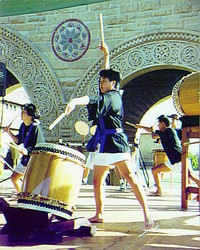
Since then, Stanford Taiko has built up its collection of drums, and developed its own style of performance. Stanford Taiko has an entirely original, student-composed repertoire, and has built all of their chu-daiko. Members of Stanford Taiko have also been making their own drums and sewing their performance costumes since the group started back in 1991-92. Currently, members of the group have designed and sewn a series of happi that represent both natural and aesthetic elements; fire, water, air, and spirit.
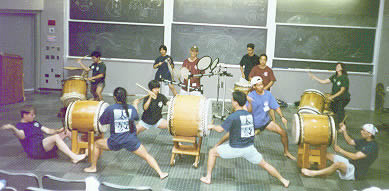
Stanford Taiko has grown to an ensemble of 15 to 20 members with an all-original repertoire and the sponsorship of the Stanford Music Department. Members are selected through a one-month audition process that commences at the beginning of each academic year. The group performs regularly at major campus events, including Baccalaureate, Admit Weekend, New Student Orientation, and Parent's Weekend. Stanford Taiko also contributes to the department of music's academic curriculum through its support of Stanford's research seminar Perspectives in North American Taiko.
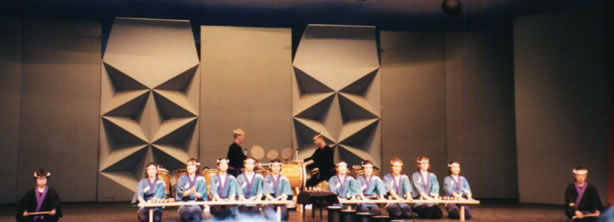
In 1995, Stanford Taiko founded the Collegiate Taiko Invitational, an annual event that brings together collegiate taiko groups from across the country to help strengthen the intercollegiate taiko community. The Invitational has almost tripled in size since its inception; this year over 140 taiko players representing over 10 groups participated in the event. Stanford Taiko has also concertized internationally. They have toured Japan, Maui (where they also learned how to construct better wine-barrel drums), and in the summer of 2004, Thailand, where they performed at Thailand's National Theatre.
On occasion, Stanford Taiko participates in Music Department projects. For example, in spring 1999 the group premiered a work composed as a commission to celebrate the 50th anniversary of the Peninsula Symphony Orchestra, a collaboration of symphony orchestra, chorus, and taiko ensemble by renowned Chinese Canadian composer Melissa Hui.
Many Stanford Taiko members have gone on to perform with or form other professional taiko groups, including On Ensemble, Portland Taiko, and playing with Kenny Endo-sensei. Though the faces of Stanford Taiko change with the regularity of the four-year collegiate cycle, the energy of the organization remains forward-moving as we work to keep the taiko spirit strong and steady in the Stanford community, sharing our music, our energy, and the art that we love.
© Stanford Taiko 2006

