
Nam-Joon
Cho's

Development of Membrane on a Chip Technology
The central objective of my research is to understand molecular recognition events between biological systems and engineered membrane platforms. Depending on the macromolecular interaction of interest, an appropriately chosen combination of sensor and biomimetic platform is needed to detect and characterize the interaction.
Novel Membrane Platforms
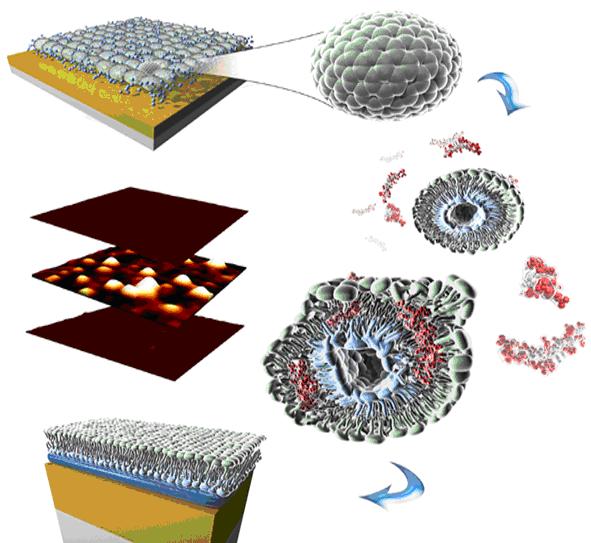
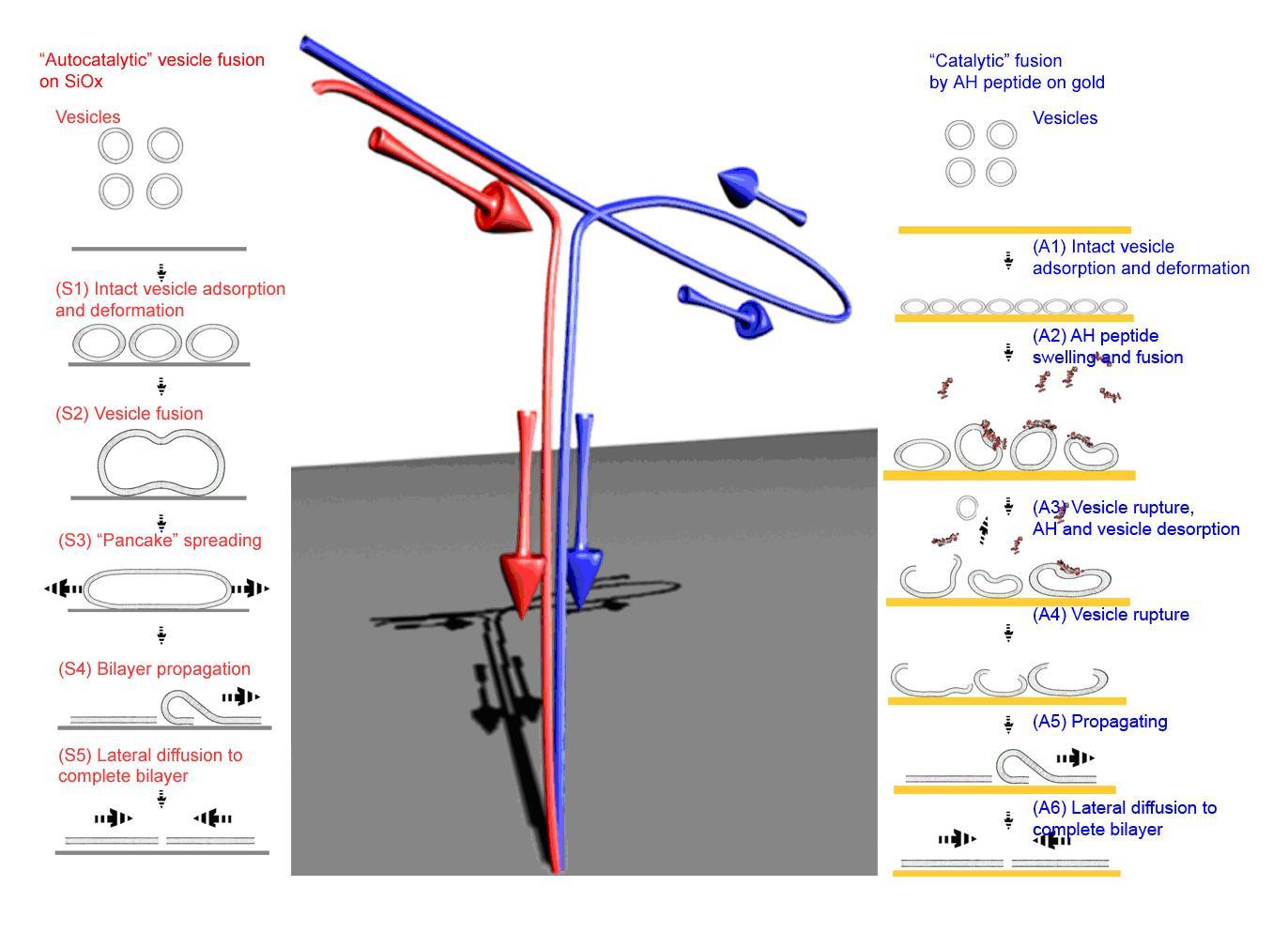
Solid-supported lipid bilayers formed by the fusion of small unilamellar lipid vesicles onto silicon oxide or organic film-modified surfaces enable the biofunctionalization of inorganic solids such as semiconductors, gold-covered surfaces, and optoelectronic lab-on-a-chip devices. These biomimetic platforms have proven to be a valuable model system for physiological membranes due to their similar physical and chemical properties, ease of use, and high mechanical stability. Past studies have demonstrated their effectiveness for studying membrane-associated proteins, membrane-mediated cellular processes, protein-lipid interactions, and signal transduction pathways. However, researchers have been limited in their selection of surface materials for solid-supported bilayers.
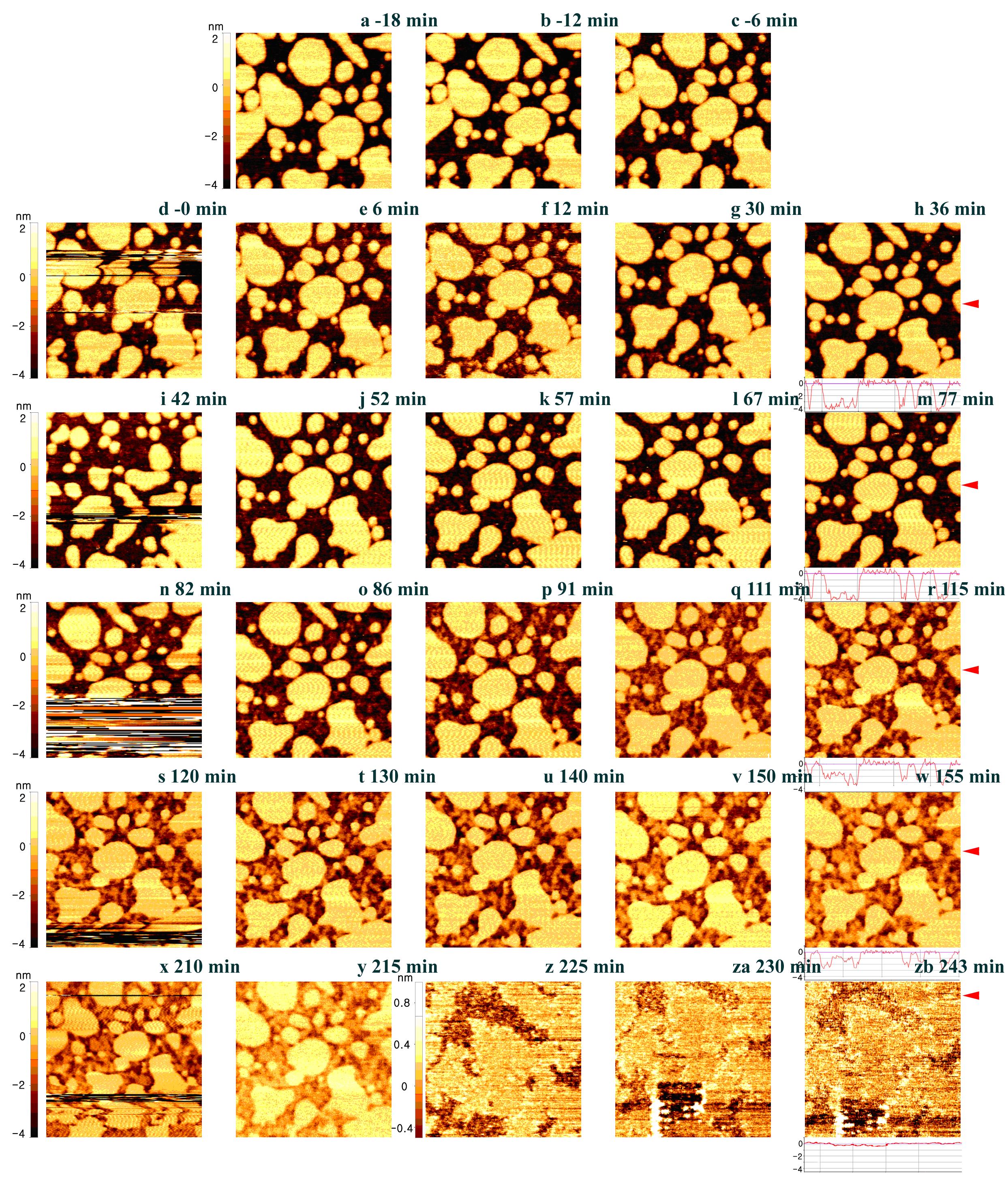
We developed a method to form planar bilayers on gold and titanium oxide that shifts the focus away from surface-dependent constraints to a material-based solution. The interaction of a specific viral peptide with surface-adsorbed, intact lipid vesicles can destabilize the vesicles, leading to lipid bilayer formation on gold and titanium oxide. The favorable electrical properties of gold and the biocompatibility of titanium oxide make these substrates attractive for a wide range of biosensor and lab-on-a-chip device applications. We are currently investigating the electrochemical properties of these membrane platforms.
The central objective of my research is to understand molecular recognition events between biological systems and engineered membrane platforms. Depending on the macromolecular interaction of interest, an appropriately chosen combination of sensor and biomimetic platform is needed to detect and characterize the interaction.
Novel Membrane Platforms
Solid-supported lipid bilayers formed by the fusion of small unilamellar lipid vesicles onto silicon oxide or organic film-modified surfaces enable the biofunctionalization of inorganic solids such as semiconductors, gold-covered surfaces, and optoelectronic lab-on-a-chip devices. These biomimetic platforms have proven to be a valuable model system for physiological membranes due to their similar physical and chemical properties, ease of use, and high mechanical stability. Past studies have demonstrated their effectiveness for studying membrane-associated proteins, membrane-mediated cellular processes, protein-lipid interactions, and signal transduction pathways. However, researchers have been limited in their selection of surface materials for solid-supported bilayers.
We developed a method to form planar bilayers on gold and titanium oxide that shifts the focus away from surface-dependent constraints to a material-based solution. The interaction of a specific viral peptide with surface-adsorbed, intact lipid vesicles can destabilize the vesicles, leading to lipid bilayer formation on gold and titanium oxide. The favorable electrical properties of gold and the biocompatibility of titanium oxide make these substrates attractive for a wide range of biosensor and lab-on-a-chip device applications. We are currently investigating the electrochemical properties of these membrane platforms.
Another
active area of research is the development of biomembrane-on-a-chip technology
wherein sensor chips are functionalized with biologic membranes. Compared to the
difficulties associated with complex biomembrane structures, model membranes
offer the advantage of studying one or a few membrane components in isolation.
Nonetheless, employing both model and cell-derived membrane platforms can
improve our mechanistic understanding of macromolecular interactions by
separating membrane-protein interactions from protein-protein
interactions. Previously, we have proven the existence of a protein
receptor in specific cell membranes by measuring the binding dynamics of a viral
peptide to both types of membrane. With results comparable to those obtained by
traditional biochemical analysis, these sensor platforms are simple, quick to
use, and show the real-time kinetics of macromolecular interactions with
membranes.
Combined Sensor Measurements
As biomimetic membrane platforms become more complex, there is an increasing need to simultaneously measure several independent physical parameters in order to correctly and precisely interpret biomacromolecular interactions. By simultaneously using the acoustic-based quartz crystal microbalance with dissipation monitoring (QCM-D) and optical reflectometry to monitor interfacial phenomena, we have been able to analyze in situ the dynamics of multistep, biological processes by combining two measurements that rely on fundamentally different physical principles. These studies have improved our knowledge of a viral peptide's membrane association, and have also led to new understanding about the self-assembly of solid-supported lipid bilayers.
Combined Sensor Measurements
As biomimetic membrane platforms become more complex, there is an increasing need to simultaneously measure several independent physical parameters in order to correctly and precisely interpret biomacromolecular interactions. By simultaneously using the acoustic-based quartz crystal microbalance with dissipation monitoring (QCM-D) and optical reflectometry to monitor interfacial phenomena, we have been able to analyze in situ the dynamics of multistep, biological processes by combining two measurements that rely on fundamentally different physical principles. These studies have improved our knowledge of a viral peptide's membrane association, and have also led to new understanding about the self-assembly of solid-supported lipid bilayers.
Recently, we
have also demonstrated with combined QCM-D and cyclic voltammetry measurements
that lipid monolayers and bilayers supported on gold are excellent electrical
insulators. These combined measurements prove useful for monitoring both the
mass and viscoelastic properties of the adlayer as well as the adlayer's
structural integrity. In the case of the supported bilayer on gold, this finding
has great potential for biosensor development since the bilayer also retains its
cell membrane-mimicking properties. Future work in collaboration with Professor
Fredrik Hook of Chalmers University of Technology will focus on the applications
of other combined measurement systems, including coupling the QCM-D technique
with surface plasmon resonance (SPR), ellipsometry, and fluorescence microscopy.
Biocompatible Membrane Patterning
Patterned membrane platforms with partition-defined areas of freely mobile lipid bilayers have a wide range of potential sensing, biotechnology, and high-throughput screening applications. One common way to create diffusion barriers for fluid membranes involves the use of substrates on which patterns of foreign barrier materials have been deposited prior to the assembly of the supported lipid bilayer. However, conventional inorganic barriers reduce the platform's biomimetic character by imposing a nonbiological material within the platform, resulting in a partition with physical and chemical properties that are different from the lipid membrane surface.
Biocompatible Membrane Patterning
Patterned membrane platforms with partition-defined areas of freely mobile lipid bilayers have a wide range of potential sensing, biotechnology, and high-throughput screening applications. One common way to create diffusion barriers for fluid membranes involves the use of substrates on which patterns of foreign barrier materials have been deposited prior to the assembly of the supported lipid bilayer. However, conventional inorganic barriers reduce the platform's biomimetic character by imposing a nonbiological material within the platform, resulting in a partition with physical and chemical properties that are different from the lipid membrane surface.
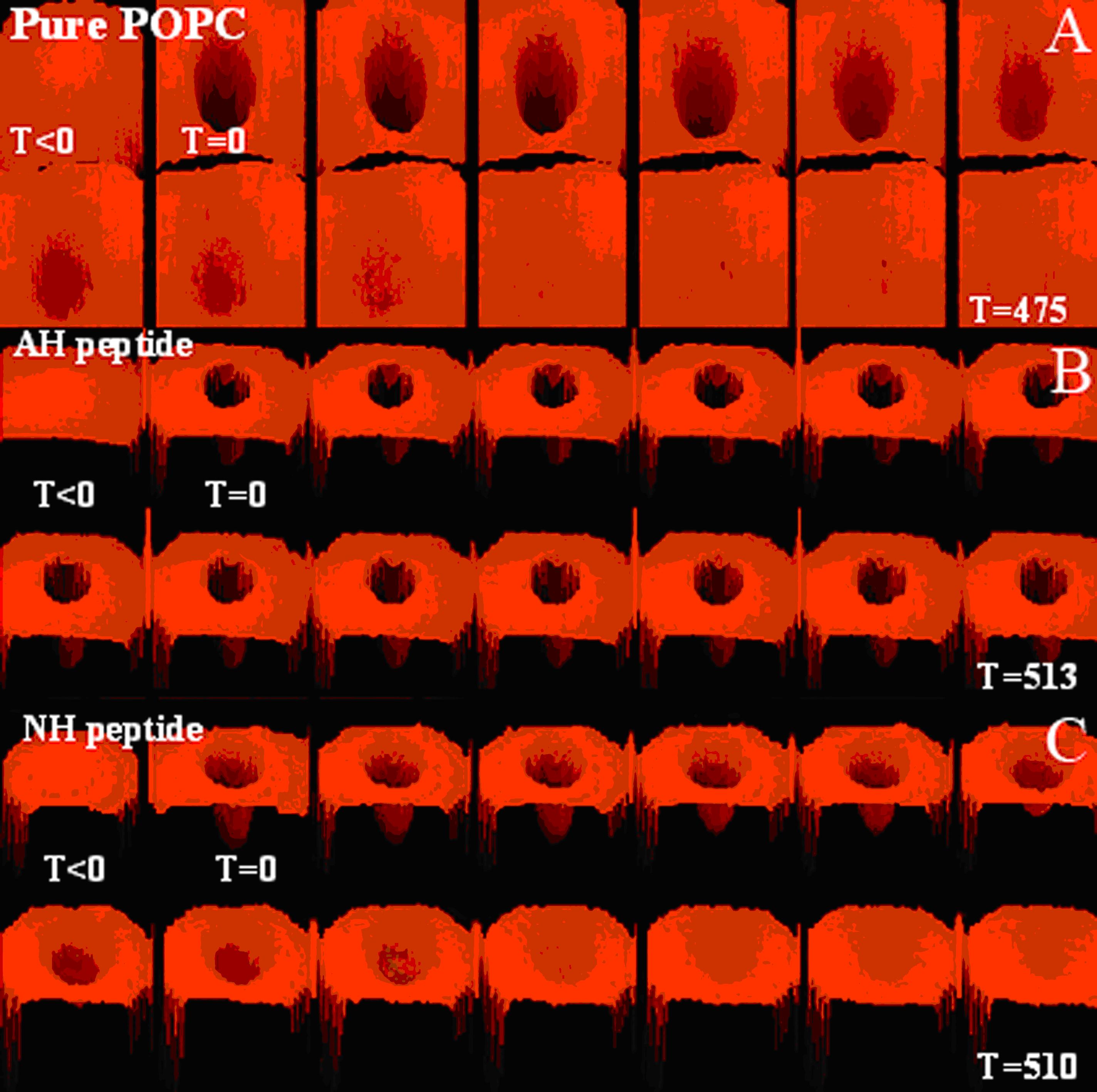
Through the
course of our studies of a viral peptide, we discovered that the interaction
between this peptide and a solid-supported lipid bilayer altered the mobility of
the bilayer. Based on this interaction, we have developed a new method to
create a biocompatible barrier by depositing the peptide on the substrate prior
to bilayer formation. The resulting barrier regions are effectively
composed of a fixed lipid monolayer on top of the patterned peptide, providing a
surface that retains the same physical and chemical properties of the lipid
bilayer itself. Future work will concentrate on the fabrication of arrays
of membrane domains that can be studied independently of each other on a single
support.