Exploring Navajo Culture | |
|
Defining Culture:
There are many definitions of culture, but the definition that we
will focus on is one that emphasizes the human and social aspects of
people. In Multicultural
Education , Banks and McGee state, “Most social scientists
today view culture as consisting primarily of the symbolic, ideational,
and intangible aspects of human societies. The essence of a culture is not
its artifacts, tools, or other tangible cultural elements but how the
members of the group interpret, use, and perceive them. It is the values,
symbols, interpretations, and perspectives that distinguish one people
from another in modernized societies; it is not material objects and other
tangible aspects of human societies. People within a culture usually
interpret the meaning of symbols, artifacts, and behaviors in the same or
in similar ways.”
The Navajo Culture: Diné The Navajo People call themselves Diné, which means “the people”. They were here long before the European, the African, the Latino, and the Asian. Yet the Diné often think of themselves as the forgotten people.
Navajo families
belong to clans. Families are very traditional, they were nomadic historically
and made their livelihood as sheepherders. They continue to herd sheep
and also to farm. Mutton is a major source of food. |
|
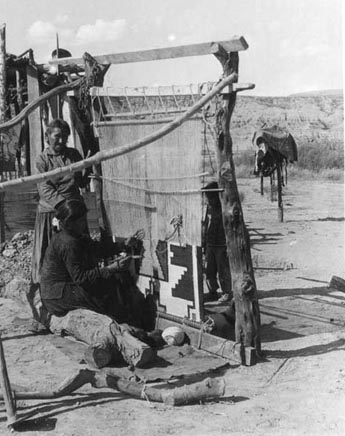 The wool is spun and woven to make clothing. The Navajo
are also renowned weavers of rugs. Many Navajo arts continue to be passed
on, as daughters and granddaughters learn to weave, make baskets, mold
pottery, and bead jewelry.
The wool is spun and woven to make clothing. The Navajo
are also renowned weavers of rugs. Many Navajo arts continue to be passed
on, as daughters and granddaughters learn to weave, make baskets, mold
pottery, and bead jewelry.Website created by Darlene
Anaya