AN INTRODUCTION TO THE CULTURE OF THE REPUBLICA DE
EL SALVADOR
Welcome to my web page on El Salvador. I chose this topic because I have students,
a coworker and friends from this beautiful country. I feel that I will be a
more affective teacher if I am familiar with my students’ backgrounds and
cultures. Since I am not from the
culture, have never visited the country and do not speak Spanish, my
perspective is that of an outsider. I
have attempted to approach this project with respectful curiosity; I hope my
information is accurate. Barbara
Singleton
El
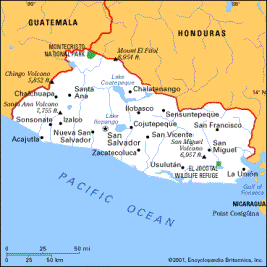
Salvador is the smallest country in Central America. Honduras lies to the north
and east, while to the southeast is the small Gulf of Fonseca, dividing the
country from Nicaragua. South is the Pacific Ocean. Guatemala lies to the west
and northwest.
Official
Name Republica de El Salvador (Republic of El Salvador)
Capital
City San Salvador
Type of
Government Republic
Population
6.2 million
Area
20,935 sq. km
Major
Ethnic Groups Mestizos (mixed Spanish and Amerindian), Amerindian, European
Language
Spanish
Religion
Christianity
Unit of
Currency Colon, American Dollar
National
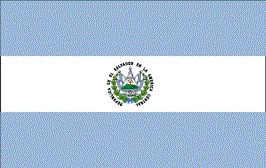
Flag Tricolour consisting of a white stripe between two horizontal blue
stripes. The national motto, Dios Union Y Libertad (God, Unity and Liberty),
appears in the centre of the white stripe.
Date of
Independence September 15,1821
(http://www.settlement.org/cp/english/elsalvador/)
DEFINING CULTURE
“It is difficult to
talk about culture or develop plans for learning about another culture without
first wrestling with the meaning of this term. Although it is the cornerstone
of cultural anthropology, anthropologists themselves do not agree on a shared
meaning. It is no surprise, then, that people who think anthropologists should
have a handy definition are nonplussed when they learn that huge verbal
struggles take place over this concept. Some anthropologists have even
suggested doing away with it entirely.”
(e.g., Wolcott, 1991)
(http://www.cal.org/crede/pubs/edpractice/EPR4.htm)
As one can see from the above quote, defining culture is a
broad and complex undertaking. For the
purpose of this paper, I have chosen to refer to The Oxford English Dictionary
which defines cultures as “The civilization, customs, artistic achievements,
etc, of a people, esp. at a certain stage of its development or history.” (The
Oxford English Dictionary, second edition)
For more in-depth information on defining culture, refer to
the following web sites:
http://carla.acad.umn.edu/culture.html
http://www.wsu.edu/gened/learn-modules/top_culture/culture-definition.html
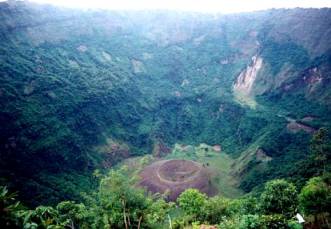
Inside the San Salvador volcano
crater, located near San Salvador, the capitol city
“El Salvador is a mountainous country. Two
major ranges, the Coastal Range and the Sierra Madre, cross the country from
east to west. The volcanoes benefit Salvadorans by providing rich, fertile soil
for farming. Many towns and cities, such as the capital of San Salvador, are
located near volcano bases. Some volcano craters are filled with deep lakes,
while rivers such as the Rio Lempa, the country’s largest, gush down from the
mountains. Tectonic activity from volcanoes means that El Salvador is prone to
earthquakes.
Between the mountain
ranges lies a central plateau. This area is the largest and most populated part
of the country, home to San Salvador and other cities. The narrow Pacific coastal belt is a
lowland area of heavy farming. Most
rural land in El Salvador has been converted to farms. Dense population and deforestation have
destroyed the habitat of many animals, although monkeys, jaguars, coyotes,
pumas, boa constrictors and iguanas can still be found.
Climate varies in El Salvador according to elevation. The lowlands have a tropical climate, the plateau has a semitropical climate, and mountain areas experience more temperate weather. The country has only two seasons: the dry summer season, lasting from October to April, and a wet winter season from May to September, when rain occurs almost daily. Temperatures in San Salvador average around 30°C every day, and hover around 22°C at night.” (http://www.settlement.org/cp/english/elsalvador/)
In January 13, 2001 a major earthquake hit El Salvador at 11:33AM. Its magnitude was estimated at 7.6. Exactly a month later, on February 13, 2001, another large earthquake (magnitude 6.6) hit at 8:22AM. During this time period, there were numerous smaller tremors. The earthquakes destroyed many houses and disrupted the economy and infrastructure of the country. Hurricane Mitch in 1998 also caused a lot of damage.
(http://www.eeri.org/earthquakes/Reconn/ElSalvador/elsalvador2001.html)
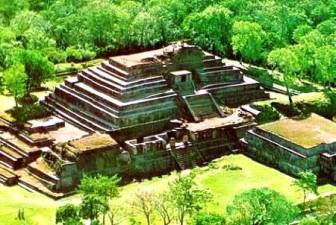
Main pyramid at the El Tazumal
archeological area Santa Ana Province
“El Salvador was one of
the great, ancient Central American civilizations, inhabited by a number of
Amerindian ethnic groups. When the Spanish invaded in 1519, El Salvador was
controlled by the Pipil, who were related to the Aztecs through their Nahuat
language. The country was then called Cuzcatlán, Land of Jewels. El Salvador was an organized state with
laws, taxes and temples. Its trading routes extended over two continents;
Salvadoran astronomy and mathematical systems were more advanced than those of
Europe.
As in
other Central American countries, Spanish colonialism destroyed much of the
native culture. The Spanish created large plantations for cotton, balsalm and
indigo (a plant used for making blue dye), and used the indigenous peoples as
labour; many died under Spanish rule
On September 15, 1821, El Salvador gained freedom from
Spanish domination, but the land was still controlled by a wealthy elite. In
1856 El Salvador separated from the federation of Central American states under
the leadership of Jose Manuel Arce, El Salvador's first president. For 70
years, a succession of governments passed laws transferring ownership of land
to the wealthy and powerful. During this time, El Salvador’s indigo industry
was replaced by coffee. Attempts by workers to unionize were met with severe
repression. In 1932, peasants revolted under the leadership of Farabundo Martí.
Government responded with mass killings, including the murder of Martí. The
first of a succession of military dictatorships was established, supported by a
select group of coffee plantation owners.
Anti-government unrest continued and attempts to elect
progressive governments proved impossible. In 1979, civil war erupted between
the socialist, revolutionary guerilla army (collectively known as the Farabundo
Martí Nation Liberation Front, or FMLN) and government-controlled military
forces receiving funding from the U.S. government.
In 1990, after repeated calls for peace talks from the FMLN,
the government agreed to negotiations mediated by the United Nations, and on
January 16, 1992, a ceasefire agreement was signed. El Salvador now has
legitimate elections and an improved human rights record. The FMLN has become
an opposition party, and in March 2000, won the largest block in the
legislative assembly. While the current president, Francisco Flores, is a
conservative, the FMLN have gained the majority of municipal elections
throughout the country.” (http://www.settlement.org/cp/english/elsalvador/)
Coffee is the main cash crop of El Salvador.
(http://www.settlement.org/cp/english/elsalvador/)
“Education is free and compulsory in El Salvador for
six years at the primary level. Student pass through four levels of school: parvularia
(preschool), basica (grades one through nine), media (grades
10 to 12) and superior (post-secondary education). The curricula of
primary and secondary schools is similar to North American schools, and
includes history, geography, physical education, mathematics, computer studies
and literature. El Salvador also has a private school system; many of these
schools are administered by the Roman Catholic Church or other religious
groups.”
(http://www.settlement.org/cp/english/elsalvador/)
For more information and links to El Salvador, go to:
http://www.settlement.org/cp/english/elsalvador
http://www.reliefweb.int/w/rwb.nsf/vBS?OpenView&StartKey=El+Salvador:+Country+Profiles&ExpandView
PEOPLE AND LANGUAGE
The estimated population of El
Salvador is 6,353,681. 90% are mixed Amerindian
and White. 1% are indigenous Amerindian and 9% are White.
(http://www.brainyatlas.com/geos/es.html#People)
The official language is
Spanish. A small percentage of the population
speaks Amerindian languages.
For more information go
to: (http://www.ethnologue.com/show_country.asp?name=El+Salvador)
Resources in San
Francisco for Spanish language books for children:
LA CASA DEL LIBROS/BOOKS ON WINGS
973 Valencia Street, San Francisco
415-285-1145
www.lacaslibro.com
Specialty: Spanish Language Books / Only books in Spanish
MARIUCCIA IACONI BOOK IMPORTS, IN
970 Tennessee, San Francisco
415-821-1216
www.mibibook.com
Specialty: Spanish Language For All Ages
INTERVIEWS: A good way to get a feel for a country is to
meet the people. Following are three
interviews:
Corina F. – Parent
and paraprofessional for SFUSD. In the
USA ten years. Mother of Edwin and
Kevin. Interviewed on the job 5/7/03.
“We had a big house and my Mom was always taking care of
relatives. We had a grocery store; it
was big. My Dad was always working.”
About the earthquakes:
“After the first earthquake, it just kept happening, every five
minutes. Thousands of little tremors
between the two big ones, one in January and one in February 2001. The people were starting to settle down, when
the next one hit. We are lucky that the
house is doing well, but there are a lot of shacks. Adobe houses fell down (maybe 90%.) Every few months there is at lest one tremor.”
The economy: “The
economy crumbled with the earthquakes.
The infrastructure and services were destroyed. People survive with money sent from
here. A lot of unemployment. A lot of people still being laid off. They can’t find jobs. Everything is very expensive. They changed the currency to the US
dollar. Everything costs dollars and
the people are still earning colons.
They want to establish a minimum wage, but cost of living is really,
really high.”
Health care: “The
health system is horrible. Doctors have
been on strike since last year. They
are trying to privatize the health care system. It is socialized for the workers. The rest of the people go to the general hospitals, which are not
good.”
Education: “The
public education system is bad. My Mom
got a scholarship at a Jesuit school from my brother and me. I graduated with wealthy kids. UCA (Universidad CentroAmericana, in El
Salvador) is the best college in Central America – It’s Jesuit.”
“Salvadorians are famous for being hard working people. El Salvador is tropical. The water at the beach is warm. There is seafood all over.”
Edwin, age 9, and Kevin, age 6, visited El Salvador in Summer
2002.
Kevin said, “Every night there is always a thunder storm.”
Edwin said that he stayed with “My Grandfather and
Grandmother in San Salvador, that is the capitol city of El Salvador, for one
month and one week. I went to the
ruins. Under the stairs is two
tombs. And in the tombs are two dead
skeletons. I saw them in a picture.
These are the two things we know.”
FOOD
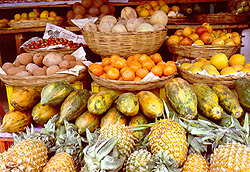
“El Salvador is the smallest and most densely
populated country in Central America. Much of the farmland is in the hands of a
few landowners. The poor people farm what little bit of land they have, growing
corn and beans to help feed their families, and buying rice if they cannot grow
it. Sugarcane, pineapples, bananas, avocados and melons grow there, but they
would not necessarily be available on a regular basis to the poorer families.
Many of the people of El Salvador have led difficult lives over the past several
years, sometimes having to leave their villages and seek shelter in refugee
camps. Joetta Handrich Schlabach, in the book Extending the table: a world
community cookbook, shares several brief stories describing the generosity
and creativity of the El Salvadorans even when times have been difficult.”
(http://www.elca.org/dgm/country_packet/el-salvador/recipe.html)
I
have included the following recipe because it contains pineapple vinegar (vinagre),
which is a staple. Many people keep a
container of it in their house.
According to my friend from El Salvador, bell pepper and radishes should
be omitted from the recipe for the curtido and apples, not peaches would
be used for the pineapple vinegar.
Otherwise, this is a traditional recipe. A complete meal might be Pinto or black beans flavored with
onion, garlic and chili powder and served over rice, with the curtido and
quesadillas and watermelon for dessert.
|
Pickled Coleslaw (El Salvador) serves
6 to 8 as salad 1
head cabbage, finely sliced 1 onion, thinly sliced 1 ½ cups pineapple vinegar: (choose
1)
Recipe from Smithsonian
Folklife Cookbook by Katherine S. and Thomas M. Kirlin, Smithsonian
Institution, 1991, p. 110 |
ART RESOURCES
Site with virtual tour of archaeological museum in San
Salvador (Museo Nacional de Antroplogia) and wonderful photos of the country:
http://www.4elsalvador.com/default.htm
Sites on contemporary art:
http://www.nortropic.com/el_salvador/art.html
(art and poetry)
http://www.cuscatla.com/arte.htm
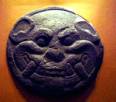
The Five tons “Jaguar Monolith” is the centerpiece of the museum Colección Maya de el Museo Nacional de Antropologia in San Salvador