Filipino Languages
|
The 1935, Philippine Constitution mandated that a national language was to be adopted and developed based on one of the existing native languages. In 1937, the Institute of National Language (INL), recommended that Tagalog be the basis for the adoption of the national language. In 1940, Executive Order No.263 was issued ordering the teaching of the national language in all public and private schools in the country. The Order also provided that the national language shall be taught forty minutes a day as a regular, required two-semester subject. The national language shall replace an elective in each semester of the second year in normal schools and shall be an additional subject of all secondary schools. Tagalog was first introduced in the fourth year of all public and private high schools and in the second year of all public and private teacher-training institutions. Tagalog became more popularized when the Japanese forces invaded the country in 1942. The Commander-in-Chief of the Japanese Imperial Forces ordered the prohibition of the use of English and the Filipino people's reliance upon Western nations, particularly the United States and Great Britain. Tagalog became the medium of instruction in schools during the Japanese regime. In 1943, Executive Order no.10 mandated the teaching of the national language in all elementary schools, public and private, and the training of national language teachers on a massive scale. Major emphasis was given to the development of the national language. Thus the national language became part of the curriculum at all levels. The school system was reorganized when the Americans came to liberate the Philippines from the Japanese invasion. English, again, became the principal medium of instruction with Tagalog taught as a required subject in the elementary and secondary levels. In 1957a new language policy was adopted in Philippine schools. The Board of National Education decided that the "medium of instruction in the first two grades of the elementary school shall be the local vernacular; that at the same time the national langualge shall be taught informally beginning in Grade I and given emphasis as a subject in the higher grades; that English shall be taught as a subject in Grades I and II and used as a medium of instruction beginning in Grade III." This revised Educational Program of 1957, was criticized strongly due to the observed weakness of the multilingual policy which it promoted. After 17 years of research, new policy on bilingual education was implemented. DECS Order no.25 defined the separate use of Filipino and English as a media of instruction in specific subject areas from grade I in all schools. Filipino was allocated to Social Studies/Social Science, Work Education, Character Education, Music, Health and Physical Education. All other subjects were taught in English. Filipino and English were taught as subjects in elementary and secondary schools to achieve the goals of bilingualism. In 1987, the Bilingual Education Program was revised and the national language was declared to be Filipino. The document further supported the bilingual policy as it stated, "....for the purposes of communication and instruction, the official languages of the Philippines is Filipino, and until otherwise provided by the law, English..." In 1990, a Congressional Commission was created to survey Philippine education. The EDCOM recommended the use of Filipino as language of instruction at all levels by the year 2000. In 1996 the Commission on Higher Education issued a CHED Memorandum Order (CMO) no.59 titled New General Education Curriculum (GEC). The minimum requirements included nine units in Filipino, and nine units in English, thus giving equal treatment to both languages in the curriculum. |
|
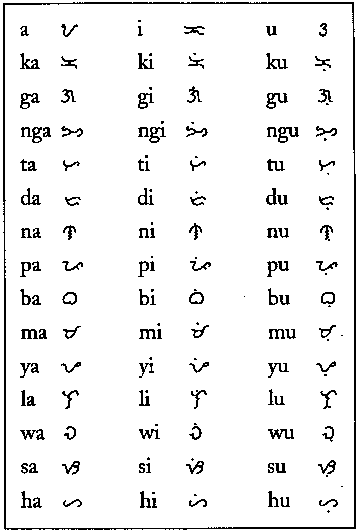
Tagalog Script The Tagalog script that the Spaniards found the people in Manila using was compliled of 17 basic symbols. There were 3 vowels and 14 consanat sounds, all ending with the a sound. The kidlit was a diacritical mark used to modify the original sounds by the use of a dot, short line or an arrowhead. This simple system, called the baybayin was again modified in 1914 by Dean Paul Vesoza of the University of Manila. This new system was called alibata and incorporated the first three letters of the Maguindanao arrangement of the Arabic letters. This script was a syllablary and contrasted to the Latin alphabet. Because of the great difficulty of the original script, modifications, or improvements were necessary. In 1620 Fr. Francisco Lopex made the first logical proposal to improve the script. He added the cross kuldit, or cross, as a diacritic to be placed under the basic script symbol. This allowed for phonemes suitable for use as a final consanant and for the language to be read as well as spoken without confusion. The Tagalog script continues to be studied by many and is a ongoing source of debate. The script in no longer in use by the people of the Philippines.
|
 |
For more information about the languages of the Philippines, try this site:
http://www.filipino-americans.com/phil_lang.html