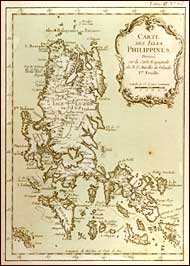
The History of the Philppines
|
|
Historical Background The Philippine
islands were first inhabited by Austronesian-speaking peoples who arrived
by boat and set up separate communities known as barangay. These were
led by a chieftain or datu, who, when Islam spread from Indonesia in the
12th-14th century, became known as sultans. The communities began to expand
in number and territory, and the status of the chieftains became known
as sultanates. The economics
of this time ranged from hunting and fishing, slash and burn agriculture,
and the eventual development of the intricate rice terraces, which are
a hydraulic engineering marvel. Trading was done amongst the people of
the various barangays as well as the neighboring countries of China, Vietnam,
Malaysia, Indonesia, India and the Arab world. Some of the items traded
were betel nuts, pearls, and tortoise shells. Of they many items imported,
such as porcelain, silk, bronze gongs, and semi-precious stones, the most
important item was the development of writing through trade. In 1521 Ferdinand
Magellan landed and claimed the Philippines for Spain. After his death,
Miguel Lopez de Legaspi began the colonization of the country and renamed
it after King Philip the II of Spain. The Philippines
remained under Spanish rule for over 300 years. The majority of the country
converted to Roman Catholicism, with only certain regions resisting and
retaining Muslim beliefs. The Spaniards exploited the people and their
lands, and then turned the wealth and ownership over to the Church. This
helped to develop a rigid class structure based on the control of agricultural
land. The landowners ruled the peasants and agricultural workers and eventually
created a region used only for producing and exporting goods for the profit
of Spain. The Spanish troops continued to push agriculture in the Philippines,
eventually developing large plantations of sugar and hemp. In 1898 an U.S. fleet led by Commodore George Dewy destroyed the Spanish fleet at the battle of Manila Bay. Under the Treaty of Paris, Spain ceded the Philippines to the United States. The U.S. soon moved to secure the Philippines as a colonial holding, and in doing so killed one-sixth of the country's population.
The Japanese
were interested in the Philippine territories in order to expand their
economic zone throughout Southeast Asia. In 1941, the Japanese air force
attacked the Philippines. They soon moved their army and navy into the
islands and occupied it until 1945, when the U.S. regained Manila and
Baguio City by bombing them. In 1946 the United States granted the Philippines independence. The economic ties, preferential tariffs, special treatment of U.S. investors and military presence persists to this day.
|