ChargePoint started in 2007 as Coulomb Technologies, a company selling electric vehicle charging stations to municipalities, utilities, and private companies. Its founders were Richard Lowenthal, Harjinder Bhade, Praveen Mandal, Tom Tormey, and Dave Baxter, who saw the need for an expansive charging network even before many electric vehicles were on the road. Early venture funding came from companies including Voyager Capital and Rho Ventures.N
In 2009, two years after the company’s founding, there were only 2,500 electric vehicles on the road in the United States.N Some of the first ChargePoint stations were in San Jose, California,N and Chicago. Drivers could locate stations using Blackberry smartphones, and find out, in real time, which ones were in use. Other features included text messages that told users when their cars were fully charged.
The market evolved rapidly. By early 2015, more than 280,000 electric vehicles had been sold in the United States.N ChargePoint had raised more than $100 million in venture funding, had more than 20,000 places to charge across North America, and had begun expanding to several global markets. It had introduced home chargers and was partnering with BMW and Volkswagen to build fast charging corridors that would allow East Coast EV drivers to travel from Boston to Washington, and West Coast EV drivers to travel from Portland, Oregon, to San Diego.N
ChargePoint home chargers cost between $499 and $749, while commercial stations ranged into the thousands of dollars; the cost of stations could, in some jurisdictions, be offset by government credits and rebates. Drivers signed up for a ChargePoint account online or on the ChargePoint app; the app offered a number of features, including allowing them to see available charging stations in their area on various networks (not just ChargePoint’s), check station status, monitor their own energy use, and track costs. Drivers could also use the ChargePoint app to set up “tap to charge,” enabling them to simply tap the phone to a station to start a charging session.
ChargePoint’s technology enabled station owners to set the rates charged to drivers; however, many sites offered charging for free as an amenity to residents, employees, or customers. Because of the low cost of electricity, station owners could not expect to make money from the sale of electricity alone. But many saw offering the stations as a way to lure customers to their stores and keep them there longer, or regarded stations as good “branding” for their businesses.
Although ChargePoint had developed an experience for EV drivers, sold ChargePoint Home for drivers, and engaged with drivers regularly, the bulk of its business came from the businesses and others that actually purchased ChargePoint hardware and software. Yet to make its business model work, ChargePoint had to do more than just work with drivers and station owners. It had to liaise with a complex set of interest groups, including:
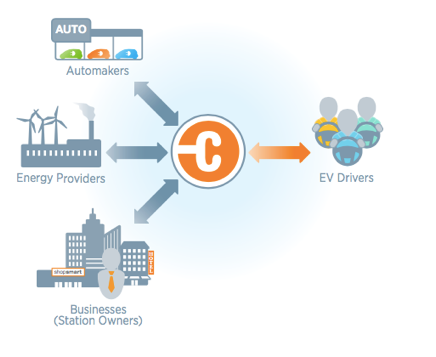
ChargePoint's many constituencies ChargePoint had to interact not only with EV drivers
but also with automakers, utilities, business owners,
legislators and regulators, and environmental groups.
ChargePoint argued that
neither the government nor utilities alone
had the funds
or expertise to build
a robust nationwide network of charging
facilities.
ChargePoint CEO Pasquale Romano in 2013“It’s going to take a boatload of dollars to get [a nationwide charging network] done. And who’s going to pay for that? There’s not a single company out there that can pay for it. A utility can’t do it, and a utility is way too constrained in other areas to have flexibility in [its] business model. There isn’t going to be a vending machine company for power that’s going to wallpaper the planet with chargers…. You have to get the private sector to want to buy it. You have to get every single company that has a parking lot attached to it to align EV charging to their business model, or their employee benefit plan, or what have you, to want to put that stuff in on their own dollars. That’s the only way this is going to work, and it’s what we’ve been plugging away at for years.”
At the start of 2015, ChargePoint competed with a number of other charging networks and charging station hardware and software suppliers, as well as automaker-built stations, including:
With a good bit of venture funding and an expansive network of chargers, ChargePoint had a strategy of selling its equipment as broadly as possible. It had a large sales staff, a significant marketing budget, and many channel partners. In contrast, some of ChargePoint’s resource-constrained, smaller competitors adopted a more niche approach.
The idea of utilities entering the market to own and operate charging stations presented some smaller competitors with a new chance to grab significant market share. If they could convince a few key utilities to buy thousands of units of their hardware, they would not need to sell to individual parking lot owners.
Some of ChargePoint’s competitors complained that while the company often talked about how it supported competition in the
EV charging market, it really wanted to keep upstarts from challenging its dominant position. They also complained that ChargePoint had received
funding from government programs, such
as the 2009
U.S. Recovery and
Reinvestment Act, and now wanted to protect its top-dog status
in the Bay Area and other key markets. N
A few of ChargePoint’s competitors, however, shared its concerns about utilities entering the market to own and operate stations. Volta Charging, for example, had built its business model on finding large companies to pay for charging stations in exchange for putting advertising on them. These ad-supported stations were free to the property owners—such as grocery stores—and the charging was free for drivers.N
Customers, Constituent Groups, and Frenemies
In the rapidly evolving electric vehicle market, alliances were constantly shifting around policy proposals. Groups that were on the same side of one bill or proposed rule could find themselves in opposition on the next. The politics of EVs could make for strange bedfellows.
For example, while casual observers might expect that environmental groups would naturally and consistently be aligned with a company like ChargePoint, that wasn’t the case. Both environmental groups and ChargePoint wanted more EV charging equipment deployed, but environmental groups sometimes supported utility EV charging proposals that ChargePoint believed would actually hurt the market.
ChargePoint had commercial relationships with automakers such as Nissan
and BMW. As an
incentive to electric vehicle buyers,
some automakers would
offer one or two years
of free charging on the ChargePoint network. But automakers also partnered directly
with utilities on charging
projects. For example,
Ford partnered with Detroit Edison
and Xtreme Power
to install a solar power system at a Ford factory in Wayne, Michigan,
and to install 10 electric vehicle-charging stations at the facility that could demonstrate battery-charging technology using renewable energy and smart-grid advances.N
In its positioning vis-à-vis utilities’ ownership of electric vehicle charging infrastructure, ChargePoint could sometimes rely on support from entities such as California’s Office of Ratepayer Advocates. With a budget of over $30 million and a staff of about 150, the ORA was funded by utility bills but acted as an independent consumer advocate within the California Public Utilities Commission. Its mission was to obtain the lowest possible rate for service consistent with safety, reliability, and the state's environmental goals. ChargePoint frequently, but not always, aligned with consumer groups like TURN (The Utility Reform Network). In addition, ChargePoint sometimes would align with business groups such as Technet and the Silicon Valley Leadership Group.
The number of plug-in electric vehicles in the United States surpassed 250,000 in late 2014, with California the largest market in the country. By the end of 2015, one out of every 200 registered cars in California was electric, and about half of all the electric cars in the United States at the time were in California.N
Global EV Sales 2011-2015N:
| Region | 2011 | 2012 | 2013 | 2014 | 2015 |
| China | 5,202 | 10,699 | 15,004 | 61,984 | 214,283 |
| W. Europe | 14,160 | 40,000 | 71,233 | 102,565 | 184,500 |
| U.S. | 17,763 | 53,169 | 97,102 | 118,882 | 115,262 |
| Japan | 12,600 | 20,667 | 28,716 | 30,567 | 46,339 |
| Canada | 275 | 1,225 | 931 | 1,521 | 5,284 |
| Total | 50,000 | 125,760 | 212,986 | 315,519 | 565,668 |
Since the 1960s, California had had the unique authority to issue vehicle emission standards that were stricter than the federal vehicle standards.N Other states could adopt California’s standards at their discretion, but under the Clean Air Act, could not adopt their own standards.
California was the first state to adopt a zero-emission vehicle mandate, requiring automakers to sell a minimum number of vehicles with zero emissions each year. In 2014, California also offered some of the best incentives to consumers to adopt electric vehicles. It offered rebates of up to $2,500 for electric vehicles and $1,500 for plug-in hybrid electric vehicles, plus permission to drive solo in carpool lanes.N In 2013, seven states (Connecticut, Maryland, Massachusetts, New York, Oregon, Rhode Island and Vermont) joined California in a pledge to put 3.3 million zero-emission vehicles on the road by 2025.N