Model uncertainty in engineering reliability analysis
Collaborators: Greg Deierlein, Stanford; Abbie Liel, University of Colorado; Curt Haselton, California State University, Chico, Michael Faber, Technical University of Denmark; Yahya Bayraktarli, BKW FMB Energy
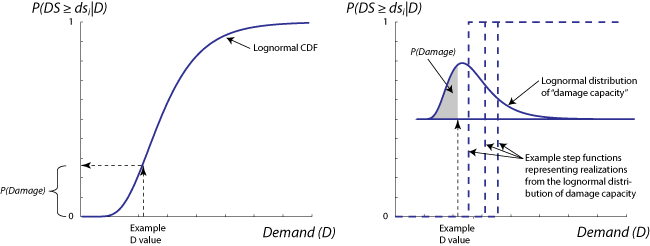
An alternate fragility function definition that facilitates correlation of component damage (from Baker, 2008).
Assessing reliability analysis of engineered systems generally requires consideration of model uncertainty due to lack of knowledge (also known as epistemic uncertainty). Quantifying this uncertainty, and capturing its effect as it propagates through the reliability analysis procedure, is important if one wants an accurate picture of the reliability of the system being studied. The publications listed below show a variety of quantification and propagation approaches for characterizing model uncertainty.
Selected publications:
 |
Gokkaya, B. U., Baker, J. W., and Deierlein, G. G. (2017). “Estimation and Impacts of Model Parameter Correlation for Seismic Performance Assessment of Reinforced Concrete Structures.” Structural Safety, 69, 68-78. |
| Baker, J. W., Gokkaya, B. U., and Deierlein, G. G. (2017). “Model parameter uncertainties and correlations: quantification and assessment of impacts on seismic collapse risk.” 12th International Conference on Structural Safety and Reliability (ICOSSAR), Vienna, Austria, 7p. |
| |
Gokkaya, B. U., Baker, J. W., and Deierlein, G. G. (2016). “Quantifying the Impacts of Modeling Uncertainties on the Seismic Drift Demands and Collapse Risk of Buildings with Implications on Seismic Design Checks.” Earthquake Engineering & Structural Dynamics, 45(10), 1661–1683. |
| Ugurhan, B., Baker, J. W., and Deierlein, G. G. (2013). “Incorporating model uncertainty in collapse reliability assessment of buildings.” 11th International Conference on Structural Safety & Reliability, New York, NY, 8p. |
|
|
Gokkaya, B. U., Baker, J. W., and Deierlein, G. G. (2015). “Illustrating a Bayesian Approach to Seismic Collapse Risk Assessment.” 12th International Conference on Applications of Statistics and Probability in Civil Engineering, ICASP12, Vancouver, Canada, 8p. |
|
|
Bayraktarli, Y. Y., Baker, J. W., and Faber, M. H. (2011). “Uncertainty treatment in earthquake modeling using Bayesian probabilistic networks.” GeoRisk, 5(1), 44–58. |
|
| Liel A., Haselton C., Deierlein G.G., and Baker J.W. (2009). "Incorporating modeling uncertainties in the assessment of seismic collapse risk of buildings," Structural Safety, 31 (2), 197-211. |
|
| Baker J.W. and Cornell C.A. (2008). Uncertainty Propagation in Probabilistic Seismic Loss Estimation, Structural Safety, 30 (3), 236-252. |
|
| Baker J.W. (2008). Introducing correlation among fragility functions for multiple components, in 14th World Conference on Earthquake Engineering, Beijing, China. 8 pp. |
|
| Baker, J.W. and Cornell, C.A. (2003). Uncertainty Specification and Propagation for Loss Estimation Using FOSM Methods. Proceedings, Ninth International Conference on Applications of Statistics and Probability in Civil Engineering (ICASP9). San Francisco, California: Millpress. 8p. |
|
| Baker, J.W. and Cornell, C.A. (2003). Uncertainty Specification and Propagation for Loss Estimation Using FOSM Methods, PEER Technical Report 2003/07. Berkeley, California. 89p. |