

Andrei Linde
Professor
of Physics
Contact Information
- office:
Department of Physics
Varian blg. 386
Stanford University
Stanford, CA 94305
- phone: (650) 723 2687 and 650 494 6106
- FAX: (650) 725 6544
- email: alinde@stanford.edu
Research
Interests
I am
one of the authors of the inflationary cosmology and of the theory of the
cosmological phase transitions. These two topics remain the main subject of my
work. Current research also involves the theory of dark energy, investigation
of the global structure and the fate of the universe, cosmological constraints
on the properties of elementary particles, and quantum cosmology.
Books
1. A.D. Linde,
INFLATION AND QUANTUM COSMOLOGY (Academic Press, Boston 1990)
2. A.D. Linde, PARTICLE PHYSICS AND INFLATIONARY
COSMOLOGY (Harwood Academic Publishers, Chur, Switzerland 1990)
Career History
- B.S., Moscow State University
- Ph.D., 1975, Lebedev Physical Institute, Moscow
- Professor, Lebedev Physical Institute, Moscow, 1985-89
- Staff Member of CERN, Switzerland, 1989-90
- Professor of Physics, Stanford University, 1990-present
- Lomonosov Award of the Academy of Sciences of the USSR,
1978
- Oskar Klein medal in physics, 2001
- Dirac medal for the development of inflationary
cosmology, 2002
- Peter Gruber Prize for for the development of
inflationary cosmology, 2004
- Humboldt Research Award, Germany, 2004
- Robinson Prize for Cosmology, Newcastle University, UK,
2005
- Medal of the Institute of Astrophysics, Paris, France,
2006
- Member of the National Academy of Sciences, 2008
- Harald Trap Friis Professor in Physics at Stanford,
2009
- Corresponding Member of the Hamburg Academy of
Sciences, Germany, 2010
- Member of the American Academy of Arts and Sciences,
2011
- Fundamental Physics Prize, 2012
- Kavli Prize, 2014
- Member of the Norwegian Academy
of Sciences and Letters, 2014
Curriculum
Vitae
Inflationary Multiverse
Inflationary
theory describes the very early stages of the evolution of the Universe, and
its structure at extremely large distances from us. For many years,
cosmologists believed that the Universe from the very beginning looked like an
expanding ball of fire. This explosive beginning of the Universe was called the
big bang. In the end of the 70's a different scenario of the evolution of the
Universe was proposed. According to this scenario, the early universe came
through the stage of inflation, exponentially rapid expansion in a kind of
unstable vacuum-like state (a state with large energy density, but without
elementary particles). Vacuum-like state in inflationary theory usually is
associated with a scalar field, which is often called ``the inflaton field.''
The stage of inflation can be very short, but the universe within this time
becomes exponentially large. Initially, inflation was considered as an
intermediate stage of the evolution of the hot universe, which was necessary to
solve many cosmological problems. At the end of inflation the scalar field
decayed, the universe became hot, and its subsequent evolution could be
described by the standard big bang theory. Thus, inflation was a part of the
big bang theory. Gradually, however, the big bang theory became a part of
inflationary cosmology. Recent versions of inflationary theory assert that
instead of being a single, expanding ball of fire described by the big bang
theory, the universe looks like a huge growing fractal. It consists of many
inflating balls that produce new balls, which in turn produce more new balls,
ad infinitum. Therefore the evolution of the universe has no end and may have
no beginning. After inflation the universe becomes divided into different
exponentially large domains inside which properties of elementary particles and
even dimension of space-time may be different. Thus the universe looks like a
multiverse consisting of many universes with different laws of low-energy
physics operating in each of them. Thus, the new cosmological theory leads to a
considerable modification of the standard point of view on the structure and
evolution of the universe and on our own place in the world. A description of
the new cosmological theory can be found, in particular, in my article The Self-Reproducing Inflationary Universe published in
Scientific American, Vol. 271, No. 5, pages 48-55, November 1994. A nice
introduction to inflation was written by the journalist and science writer John
Gribbin Cosmology for
Beginners . The new cosmological paradigm may have non-trivial philosophical implications. In particular, it provides
a scientific justification of the
cosmological anthropic principle, and allows one to discuss a possibility to create the universe in
a laboratory.
A Brief History of
the Multiverse
The
idea of an inflationary multiverse (the universe consisting of many universes
with different properties) was first proposed in 1982 in my Cambridge
University preprint Nonsingular Regenerating Inflationary
Universe . A more detailed discussion of this possibility was contained in
my paper The New Inflationary Universe Scenario
published in the book "The Very Early Universe," ed. G.W. Gibbons, S.W.
Hawking and S.Siklos, Cambridge University Press, 1983, pp. 205-249.
Implications of this picture for the "SUSY landscape" (the universe
with different properties corresponding to different vacua of supersymmetric
theories) was discussed in my paper Inflation Can Break
Symmetry In SUSY, Phys. Lett. B131, 330 (1983). A major step in the
development of the theory of the multiverse was related to the discovery of
eternal inflation; for a discussion of its anthropic implications see the last
page of my paper Eternally Existing Self-Reproducing
Chaotic Inflationary Universe, Phys. Lett. B175, 395 (1986). The methods of
calculation of the probability to live in the parts of the universe with
different properties were developed in my paper with Dimitri Linde and Arthur
Mezhlumian From the Big Bang
Theory to the Theory of a Stationary Universe, in my paper with Juan
Garcia-Bellido and Dimitri Linde Fluctuations
of the Gravitational Constant in the Inflationary Brans-Dicke Cosmology,
and in the paper by Alex Vilenkin Predictions
from Quantum Cosmology, who called these methods "the mediocrity
principle."
One
of the most important implications of the anthropic principle in the context of
inflationary multiverse is the possility to solve the cosmological constant
problem. The first anthropic solution of the cosmological constant problem was
proposed at the last page of my review article The
Inflationary Universe , Rept. Prog. Phys. 47, 925 (1984). My second
proposal was made in my paper Inflation and
Quantum Cosmology. It was written in June 1986, and published in the book
"300 years of gravitation," (Eds.: S.W. Hawking and W. Israel,
Cambridge Univ. Press, 1987), 604-630. The main goal of these two papers was to
propose a physical mechanism which would allow the existence of different
exponentially large parts of the universe with different values of the
cosmological constant. Until the invention of the inflationary theory, this was
an unsolvable problem. In addition to this problem addressed in my papers
mentioned above, one must also show that life can hardly exist in the parts of
the universe where the cosmological constant is much greater than the present
energy density in our part of the universe. Validity of this order-of-magnitude
condition was pretty obvious even 20 years ago, and it was taken for granted in
my works mentioned above. However, in order to have a reliable anthropic
solution for the cosmological constant problem one should know a more precise
anthropic bound on the cosmological constant. The progress in this direction
began in 1987 with the famous paper by Steven Weinberg Anthropic Bound on the
Cosmological Cosntant . His work and the subsequent developments confirmed
the assumption that the probability of existence of life of our type becomes
strongly suppressed if the cosmological constant is much greater than the
present energy density in the universe. The experimental discovery of the
cosmological constant satisfying the anthropic bound was greeted as an
experimental evidence in favour of the multiverse scenario.
One
of the most important recent steps in the development of the multiverse theory
was a discovery of the KKLT
mechanism of moduli stabilization in string theory, which allows to explain
accelerated expansion of the universe and inflation in the context of string
theory. The KKLT mechanism can lead to an incredibly large number of
different vacua, perhaps 10100 or even 101000,
corresponding to different local minima of energy in a vast string
theory landscape. This means that our multiverse may consist of
exponentially many exponentially large domains (universes), each of which may
live in accordance to one of the exponentially large variety of laws of the
low-energy physics.
Are there any
Alternatives to Inflation?
There
were many attempts to replace inflation by other theories. One attempt that
attracted a lot of attention in the media is called the ekpyrotic/cyclic
scenario. However, ekpyrotic/cyclic
scenario scenario is plagued by numerous problems. The original version of
the ekpyrotic theory, which was supposed to be a true alternative to inflation,
did not work. It was replaced by the cyclic scenario, which also suffers from
many problems, including the yet unsolved problem of the cosmological
singularity. Independently of these issues, solving the homogeneity problem in
the cyclic scenario requires an infinite sequence of periods of accelerated
expansion of the universe in a vacuum-like state, i.e. an infinite number of
inflationary stages. In this sense, instead of being a true alternative to
inflation, the cyclic scenario is a rather unusual and problematic version of
inflationary theory. Thus, at present, inflation remains the only robust
mechanism that produces density perturbations with a flat spectrum and
simultaneously solves all major cosmological problems.
Dark Energy and
the Fate of the Universe
Observational
data indicate that the universe accelerates. If this is caused by the positive
vacuum energy (cosmological constant), acceleration of the universe will
continue forever. However, recently we have found that in a broad class of
theories describing the present stage of acceleration of the universe, this
acceleration may end and the universe may eventually collapse. Rather
unexpectedly, we found that this may happen not in an extremely distant future,
as one could expect, but in about 10-20 billion years. This may happen in a
broad class of realistic theories of elementary particles, including, in
particular the popular theories based on M-theory and supergravity. This is not
a doomsday prediction because other outcomes (such as eternal acceleration of
the universe) are also theoretically possible and are equally compelling. The
only way to find out which of these possibilities is more realistic is to make
cosmological observations. These results may have important implications. One
may argue: Why do I care about the most abstract theories of elementary
particles, such as M-theory, string theory or supergravity? Why do I care about
precise measurements of cosmological parameters? Why do we need to spend
billions of dollars for the development of science? Now we can add something
new to the existing arguments: Without the development of these theories and
without cosmological observations we will be unable to know the fate of the
universe and the fate of the mankind. Here one can find a popular
discussion of our work (see also an article in SF
Chronicle).


1.
Self-Reproduction of the Universe
Inflationary
cosmology is different in many respects from the standard big bang cosmology.
Domains of the inflationary universe with sufficiently large energy density
permanently produce new inflationary domains due to stochastic processes of
generation of the long-wave perturbations of the scalar field. Therefore the
evolution of the universe in the inflationary scenario has no end and may have
no beginning. Here we present the results of computer simulations of generation
of quantum fluctuations in the inflationary universe. These processes should
occur in the very early universe, at the densities just below the Planck
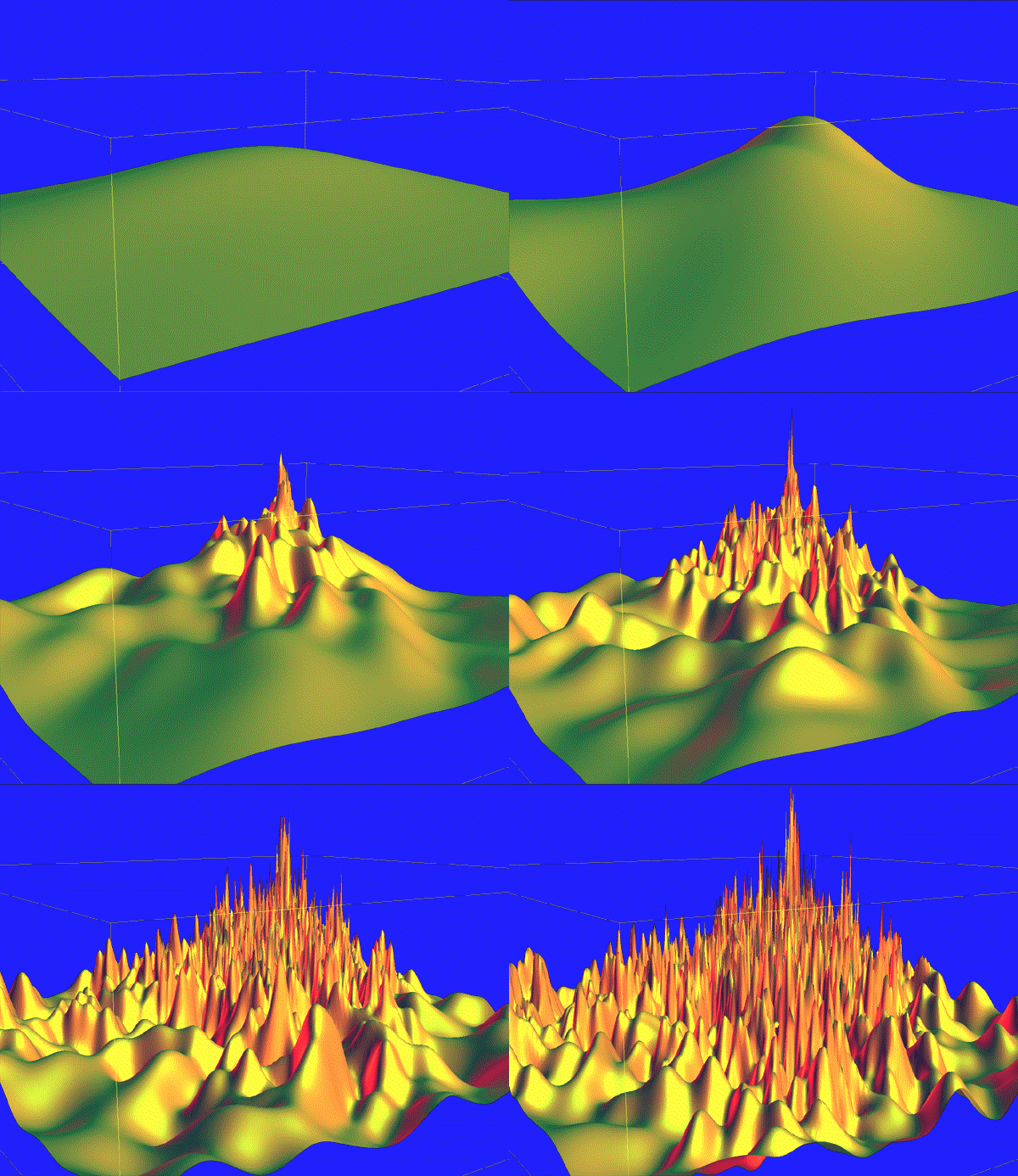
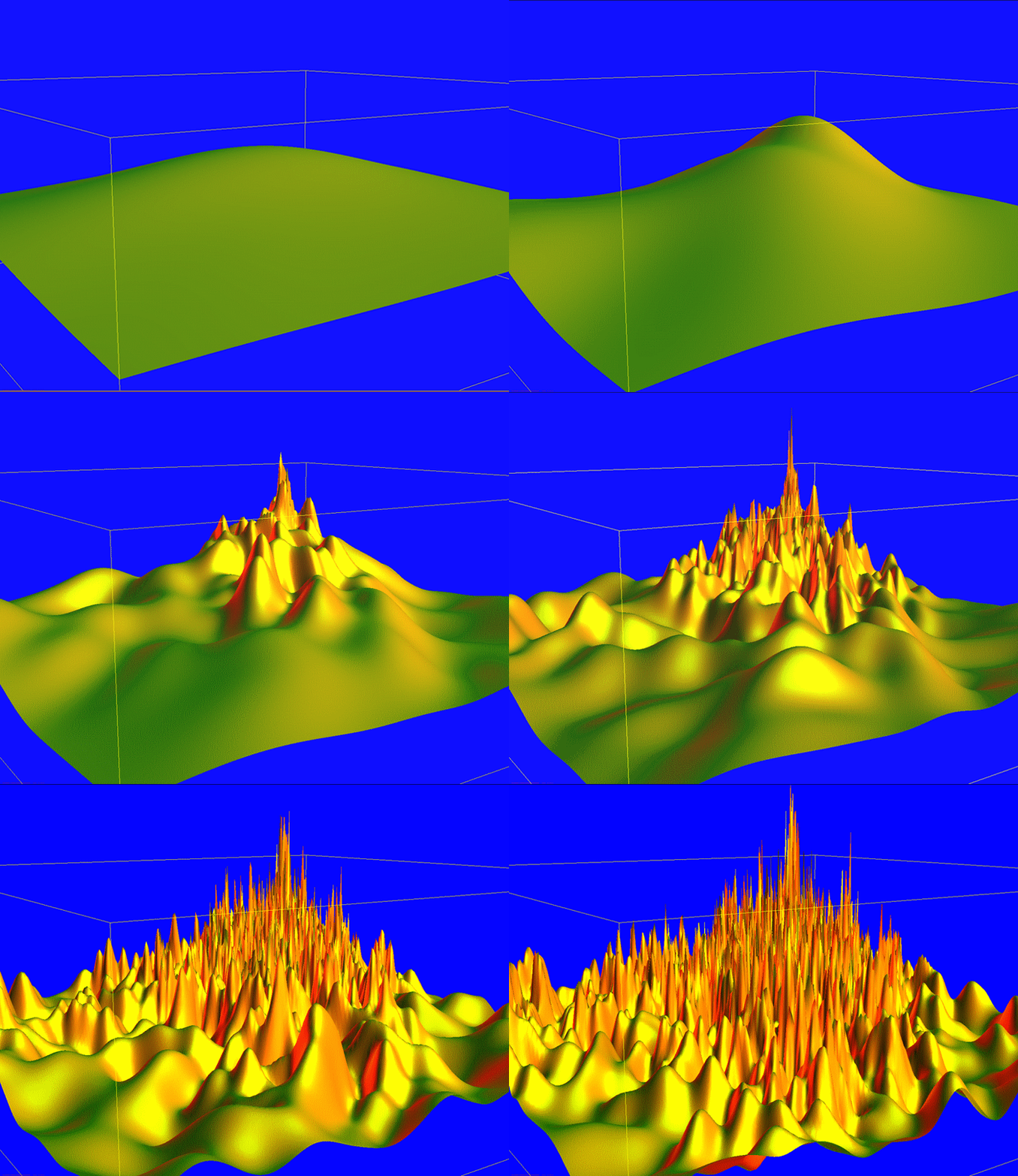
density. 1) Series of figures in gold show generation of fluctuations of the
scalar field $\varphi$ during inflation. Classically, the value of this field
should decrease, but quantum perturbations lead to formation of exponentially
large domains containing the scalar field which is much bigger than its initial
value. In particular, calculation of the volume of the parts of the universe
corresponding to the peaks of the ``mountains'' shows that it is much bigger
than the volume of the parts where the scalar field rolled to the minimum of
its energy density.
- Fluctuating inflaton field can
be viewed in gif format (0.5 Mb).
- The same results can be seen at a greater
resolution in gif format (9.6 Mb).
2)
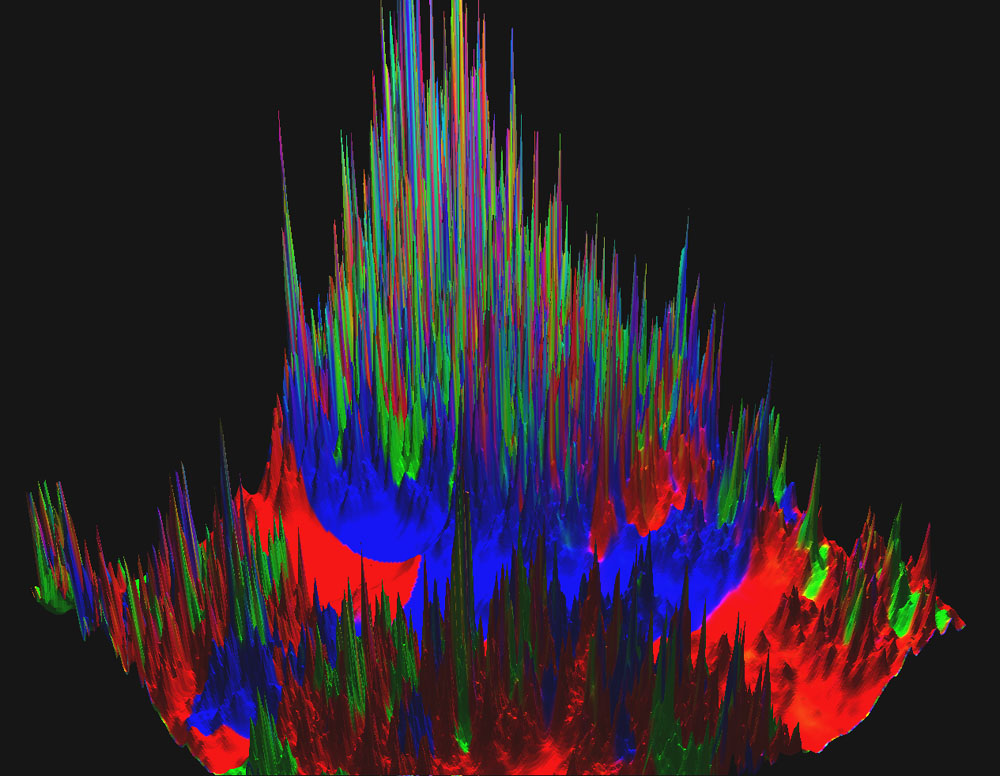
Series of figures in red, blue and green show evolution of another scalar
field, which has three different minima of its potential energy density. In the
regions when the inflaton field is large (it is represented by the hight of the
mountains), the second field strongly fluctuates. In the domains where the
inflaton field is small, the second field relaxes near one of the three minima
of its potential energy density, shown by red, blue and green correspondingly.
Each such domain is exponentially large. If the second field is responsible for
symmetry breaking in the theory, then the laws of low-energy physics inside
domains of different colors are different. The universe globally looks not like
an expanding ball, but like a huge fractal consisting of exponentially large domains
permanently produced during inflation.
- Fluctuations of the inflaton field
(shown as the hight of the mountains) and of the second field (shown by
dirrerent colors, depending on its value) in gif format.
- The same results can be seen at a much greater resolution in gif format (1.6 Mb).


3)
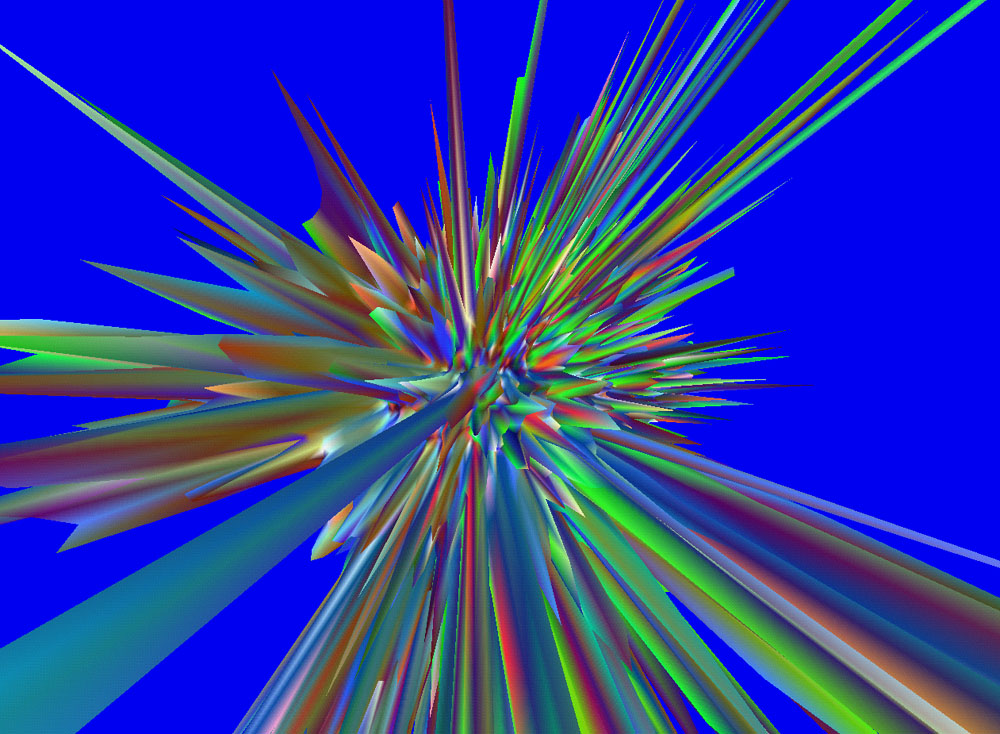
The third movie shows only the evolution of the second field, determining the
choice of the symmetry breaking (shown by dirrerent colors), so the images are
two-dimensional. This made it possible to perform simulations on a much greater
scale and with a much better resolution. We called this series of images
``Kandinsky universe,'' after the famous Russian abstractionist.
- Kandinsky universe in gif
format (6.6 Mb).

Images
- Inflationary Multiverse JPG
file 0.8 Mb and TIFF file 0.9 Mb
- Self-reproducing Universe with two scalar fields JPG file 0.3 Mb and TIFF file 3.6 Mb
- Exploding Universe JPG file 0.35 Mb and
TIFF file 3.5 Mb
- Series of 4 images of a self-reproducing Universe with
one scalar field ("Golden hills of California") 1
, 2 , 3 and 4 . Each file is 3.6 Mb
- Kandinsky Universe 0.1 Mb jpg
file (beginning of simulations)
- Kandinsky Universe 0.5 Mb jpg
file (late stages of simulations)
- Hawking-Turok instanton
describing creation of an open universe 0.1 Mb eps file
- Titanic instanton; details of
the project 0.1 Mb eps file
- Titanic instanton under the
Golden Gate bridge 0.1 Mb jpg file




Publications
PowerPoint Talks
· SUSY2008