

March 12, 2008
Learn at Your Laptop
STM Publishers Clarify Position on Authors’ Rights
Posted on Liblicense-L, 10 March 2008.
OXFORD, UK, MONDAY, 10 MARCH 2008 1700GMT.
The debate on the rights that authors have (or indeed it is claimed inaccurately, do not have) over their published works continues to rage, and much coverage has been given to purportedly restrictive practices or policies, when in fact they do not exist for the majority of publishers. The most recent examples surround the vote of the Faculty of Arts and Sciences at Harvard for university ownership and distribution of research papers (February 2008). One advocate of the Harvard policy claims that this step was taken because “the scholarly publishing system has become far more restrictive than it need be [… m]any publishers will not even allow scholars to use and distribute their own work.” (See Harvard to collect, disseminate scholarly articles for faculty, from the Harvard University Gazette).
This is not only an inaccurate perception of the role of publishers and copyright, but also means that advocating authors to modify existing journal publishing agreements with “copyright addenda” is simply a call for needless bureaucracy.
SPARC, Science Commons, and ARL Offer Options for University Implementation of New NIH Public Access Policy
White Paper by Leading Copyright Scholar Helps Grantees Prepare for April Start of NIH Requirement
Washington, DC and Cambridge, MA — February 29, 2008 — SPARC (the Scholarly Publishing and Academic Resources Coalition), Science Commons, and the Association of Research Libraries (ARL) have jointly released a white paper to help university and medical school administrators ensure their institutions comply with public access requirements that are soon to be a condition of National Institutes of Health (NIH) funding.
Falconer Biology Library Implements Card Access for After-Hours Use
Falconer Library is implementing after-hours card access. Access when the library is open will not be affected by this change. Effective Monday, March 10, any physical keys for Falconer’s front door will no longer function. Access will be by use of an authorized Stanford ID only, and only facilities and emergency personnel will have a physical key.
Faculty, graduate students, postdocs, and academic staff are eligible for after-hours access. Orientation tours are required and can be arranged by appointment. For grad students and postdocs outside Biology, Falconer requires an email message from the student’s adviser stating that the student needs 24-hour access to Falconer’s materials. This message should be sent to falconerlibrary@stanford.edu.
March 4, 2008
New Book List for February 2008
Swain’s new book list for February 2008 is now available:
March 3, 2008
The Oxford African American Studies Center

Celebrate Black History Month all year, learn about African American scientists and engineers
The Oxford African American Studies Center combines the authority of carefully edited reference works with sophisticated technology to create the most comprehensive collection of scholarship available online to focus on the lives and events which have shaped African American and African history and culture.
Precise search and browse capabilities allow users to refine their results by specific eras and subject categories. And users can choose to view biographies, subject entries, primary sources, images, maps, or charts and tables when searching or browsing. The site’s thematic timelines and Learning Center resources also provide users with powerful tools for navigating the content.
Writing Guidelines for Engineering and Science Students
Crafting meaningful and articulate lab presentations and correspondence can be difficult for anyone, including engineers and other scientists. The Virginia Tech Writing Guidelines site is designed to teach engineering and science students about creating and writing materials such as resumes, formal laboratory reports, presentation slides, and so on. The guidelines are gathered into several different sections, including “Introduction”, “Presentations”, “Correspondence”, and “Formal Reports”. There is material for instructors here as well, and the offerings include pieces on the design of writing assignments, the interactive teaching of writing, and the evaluation of writing assignments. Finally, the site also contains a number of writing exercises on grammar, punctuation, and word usage. [KMG] Source: The Scout Report, February 15, 2008.
Distillations
Distillations is a weekly science podcast that brings you extracts from the past, present, and future of chemistry. Join host Robert D. Hicks for a new episode every Friday with interviews, monologues, reviews, features, and more, to gain historical perspective on current scientific issues. Brought to you from the Chemical Heritage Foundation in Philadelphia, their web site includes additional information about each show as well as archived podcasts.
Library of Congress: Science Reference Services
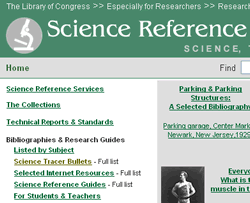
As one of the world’s premier libraries, the Library of Congress has many staff members dedicated to helping members of the general public find the information they need. Along with providing in-person assistance in Washington, D.C., they also maintain this nifty Science Reference Services site designed for persons looking for science reference material online. There is not much that isn’t included on the site, as visitors can view webcasts on creating a school garden, look over research guides, and learn about “Everyday Mysteries”. The “Everyday Mysteries” feature provides answers to questions such as “Who invented electric Christmas lights?” and it can be quite addictive. Visitors should also click on over to the “Science Reference Guides” area. Here they can look at comprehensive research bibliographies on chocolate, astronomy, electric power, and dozens more. With all of this material, visitors may also want to sign up for their RSS feed. [KMG] Source of review: The Scout Report, February 15, 2008.
Science and Engineering Statistics
National Science Foundation — Division of Science Resources Statistics (SRS)
Publications, data, and analyses about the nation’s science and engineering resources

Education
Degrees, Disabilities, Elementary and Secondary, Graduate Students, International, Minorities, Postdoctorates, Universities and Colleges, Women