TWO-STEP LASER MASS SPECTROMETRY OF TERRESTRIAL AND EXTRATERRESTRIAL MATERIALS Amy Morrow, Hassan Sabbah
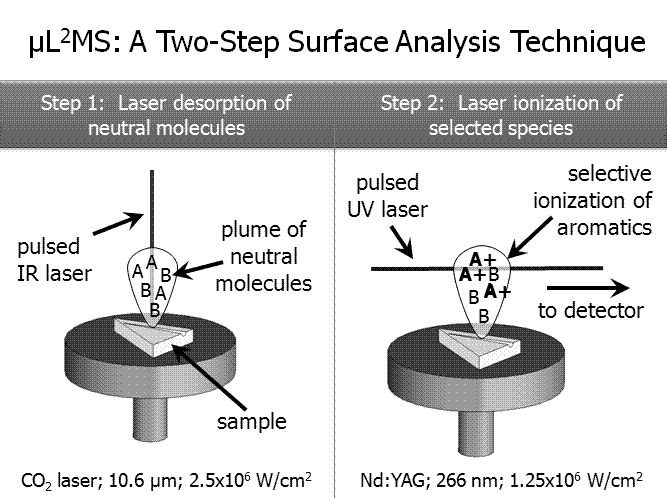
Microprobe laser-desorption laser-ionization mass spectrometry (μL2MS) is a powerful and versatile microanalytical technique that is used to study organic molecules in situ in a wide range of terrestrial and extraterrestrial materials. The combination of focused laser-assisted thermal desorption and ultrasensitive laser ionization provides sensitivity, selectivity, and spatial resolution capabilities that are unmatched by traditional methods of analysis. Over the past decade, this laboratory has developed and applied the μL2MS technique in a number of different research projects. Some areas that we are currently focusing on are:
Instrument Development: To enhance the analytical ability of the μL2MS technique we are actively pursuing instrument developments. Our plans include: the addition of a camera to visualize desorption and development of the neutral plume; installation of a dye laser to allow adjustment of the ionization laser wavelength; and modification of the sample mounting scheme to allow for more rapid sample analysis.
Stability of Organic Compounds Trapped in Aerogel: This study aims to further our understanding of the potential damaging effects of UV and proton radiation on compounds in both captured particles and innate organic compounds in low-density silica aerogel. Aerogel was a success on the NASA Stardust Mission and may be used for future particle-capture missions as well, making this a timely study.
Meteoritics: Analysis of PAHs in meteorites, meteoritic acid residues and interplanetary dust particles (IDPs). Currently, μL2MS is being used in investigating the aromatic hydrocarbon contents of the meteorite DaG 476 and fragments of the asteroid 2008TC3, otherwise known as Almahata Sitta.
Petroleomics: Recently, this instrument has been applied to the ongoing controversy over the determination of the correct molecular weight distribution in asphaltenes, a fraction of heavy oil consisting of highly polar and aromatic molecules. Currently, we are testing the ability of this technique to detect relatively high mass (~1500 amu) parent molecules while simultaneously avoiding plasma phase aggregation of low mass parent molecules that would result in a false signal at high m/z.